
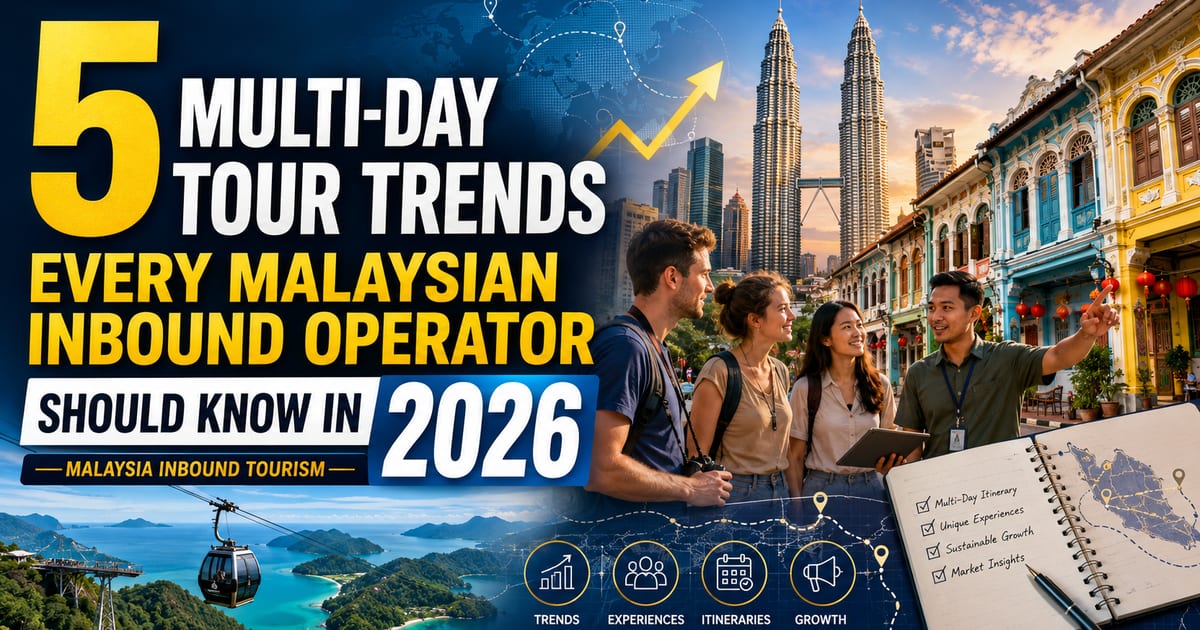
5 Multi-Day Tour Trends Every Malaysian Inbound Operator Should Know in 2026
5 Multi-Day Tour Trends Every Malaysian Inbound Operator Should Know in 2026
By Uzaidi Udanis
AI Inbound Tourism Strategist | Founder, Your Inbound Matters
Tourism has no shortage of fashionable words.
Every year, somebody announces that travellers now want slow travel, regenerative travel, transformational travel, digital detox travel or some other kind of travel that requires a PowerPoint presentation before anyone understands it.
Meanwhile, the actual tourist is standing at KLIA asking:
“Can we see the Twin Towers tonight?”
That is the difference between tourism trends discussed at conferences and tourism products people actually buy.
Recent global research involving more than 560 multi-day tour operators offers a clearer picture of what travellers are looking for in 2026. The findings are especially relevant for Malaysian inbound operators competing with Thailand, Vietnam and Indonesia for the same international visitors.
The good news is that Malaysia already has many of the ingredients travellers want.
The less-good news?
Many of those ingredients are still sitting in the kitchen instead of being placed on the menu.
Here are five important trends Malaysian inbound tourism players should understand—and act on.
1. Travellers Still Want the Famous Places
For years, the tourism industry has been telling travellers to avoid popular attractions and discover hidden gems.
But most first-time visitors are not flying twelve hours to Malaysia just to visit a hidden banana fritter stall behind someone’s house in Rawang.
They still want to see the places they have heard about:
The Petronas Twin Towers
Batu Caves
George Town
Langkawi
Melaka
Mount Kinabalu
Malaysia’s islands and rainforests
Iconic attractions remain one of the strongest reasons travellers choose a destination.
This does not mean local experiences are unimportant. It means local experiences should be designed around the destinations travellers already want to visit.
For example, a visitor does not come to Penang only for a batik workshop. The visitor may first be attracted by George Town’s UNESCO heritage status, its street art and its food.
Once the visitor is there, the operator can offer:
A street-food walk with a local storyteller
A traditional craft experience
A fishing-village dinner
A heritage photography walk
A cooking session inside a family home
The iconic attraction brings the traveller to the destination. The local experience gives the traveller a story to bring home.
Nobody returns from a holiday excitedly saying:
“The logistics were extremely efficient.”
They talk about the grandmother who taught them to cook curry, the fisherman who explained life at sea, or the local guide who knew which nasi kandar shop was worth queuing for.
What Malaysian operators should do
Do not try to replace Malaysia’s iconic attractions.
Build experiences that make those attractions more meaningful.
The Petronas Twin Towers may get the Instagram photograph. Your local experience should create the memory.
2. Small Groups Are No Longer Small Business
Multi-day tourism is moving away from large coach groups towards smaller, more personal groups.
More than two-thirds of operators in the research now offer tours for ten guests or fewer. Only around one-third continue to operate tours for thirty guests or more.
This is excellent news for Malaysian tourism SMEs.
Many local operators were never designed to manage forty tourists, three buses, eighty suitcases and one passenger who disappears every time the group needs to leave.
Our strengths have always been smaller operations:
Boutique tour companies
Independent guides
Family-run businesses
Community hosts
Small boat operators
Nature guides
Food specialists
Local artisans
In the past, being small was sometimes seen as a weakness.
Today, it can be positioned as exclusivity.
A six-person mangrove experience can provide access, flexibility and personal attention that a forty-person group cannot.
Small groups can enter local communities more respectfully. They can interact meaningfully with hosts. They can change the timing when it rains—which, in Malaysia, is not a possibility but a scheduling principle.
Small-group products can also command higher prices when the value is clearly explained.
The customer is not paying less because the group is smaller. The customer may pay more because the experience feels personal rather than mass-produced.
What Malaysian operators should do
Stop marketing small groups as a limitation.
Do not say:
“Maximum only eight guests.”
Say:
“Limited to eight guests for a more personal experience.”
Same number. Completely different value.
Operators must, however, understand Malaysia’s tourism laws and the difference between selling a licensed tour package and providing a standalone local activity. Products should be structured legally and responsibly, especially when transport, accommodation, guiding and multiple services are combined.
Small does not mean informal. Small can still be professional, premium and internationally bookable.
3. Travellers Want Choice—but Not Homework
Travellers increasingly want personalised trips.
However, most do not want to spend three weeks building their itinerary from scratch.
They want flexibility, but they also want the operator to know what they are doing.
This is where structured customisation becomes important.
Structured customisation means the operator creates a strong core itinerary but allows the traveller to choose selected activities.
For example, a three-day Langkawi package might include:
Fixed activities:
Island hopping
Mangrove experience
Cable-car visit
Choice of one additional experience:
Sunset fishing
Local cooking
Spa treatment
Night-market food walk
Traditional craft workshop
This gives the customer freedom without turning the operator’s office into an emergency control centre.
Fully customised travel can sound attractive until six travellers send six separate requests:
One wants hiking.
One wants shopping.
One wants history.
One wants no walking.
One is gluten-free.
And one says, “Anything is fine,” before rejecting every suggestion.
Structured customisation solves this problem.
The operator controls the product, costs and logistics, while the customer enjoys a sense of personal choice.
AI can also assist operators with itinerary recommendations, quotation preparation, customer profiling and costing. But AI should support a well-designed product—not attempt to rescue a confusing one.
Putting the word “AI” in front of a weak itinerary does not magically make it intelligent.
What Malaysian operators should do
Create a fixed core itinerary with two or three meaningful choices.
Do not offer twenty-seven options. That is not personalisation. That is a restaurant menu designed by a committee.
Keep the experience simple to understand, easy to price and practical to operate.
4. Travellers Want to Participate, Not Just Observe
International travellers increasingly want interaction with local people, participatory activities and experiences beyond conventional sightseeing.
They do not only want to watch.
They want to join.
There is an important difference between watching someone make batik and making your own batik.
There is a difference between photographing a fishing village and going out with the fishing community.
There is a difference between eating local food at a buffet and hearing the story of the dish from the family that prepared it.
Malaysia has an extraordinary advantage in this area.
We have Malay, Chinese, Indian, Orang Asli, Sabah and Sarawak indigenous cultures, heritage communities, fishing villages, farms, forests, islands and traditional crafts.
We have the content.
What we often lack is commercial packaging.
A village may have a fascinating traditional activity, but international tourists cannot find it online.
An artisan may have forty years of knowledge, but there is no price, schedule, booking link or English description.
A local community may be ready to receive visitors, but nobody has developed the activity into a structured two-hour experience.
Tourism assets do not automatically become tourism products.
A tourism product needs:
A clear title
A defined duration
A programme
A price
A capacity
Safety procedures
A cancellation policy
Quality photographs
An online description
A booking and payment method
Without these, we do not have a bookable experience.
We have a very interesting WhatsApp conversation.
What Malaysian operators should do
Look at what local people already do well.
Then ask:
Can visitors participate?
Can the activity be delivered consistently?
Can it be explained clearly?
Can it be priced sustainably?
Can it be booked online?
Malaysia does not need to invent culture for tourists. We need to make our authentic culture easier to discover, understand and purchase.
5. The Biggest Opportunity Is in the Middle
Luxury tourism receives a great deal of attention.
Every destination wants high-value tourists. Sometimes it sounds as though we are waiting at immigration for every visitor to show a platinum card before allowing them into the country.
But global multi-day tour data shows that the biggest commercial opportunity is often in the mid-market.
Many operators report average multi-day tour prices between US$1,000 and US$5,000 per traveller, with strong concentration in the US$2,000 to US$5,000 range.
These are not necessarily private-jet travellers.
They are ordinary international visitors who are willing to spend for:
Comfortable accommodation
Reliable transport
Good guiding
Small-group access
Cultural depth
Nature experiences
Convenience
Safety
Personal attention
This market is highly relevant to Malaysia.
We may not need to compete directly with Phuket’s resort scale or Bali’s enormous global visibility.
Malaysia can compete through value density.
In other words: how much quality, culture, comfort and variety can the traveller experience within one trip?
A ten-day Malaysian itinerary could combine:
Kuala Lumpur
Heritage
Food
Rainforest
Islands
Wildlife
Local communities
Modern city life
Muslim-friendly travel
Multicultural experiences
Few destinations can offer that range in one journey without requiring the traveller to cross three national borders and recover from four airport transfers.
However, Malaysian operators must stop assuming that cheaper always means more competitive.
Travellers do not only compare price.
They compare confidence.
Does the website look trustworthy?
Are the reviews good?
Is the itinerary clear?
Can they book immediately?
Does the operator respond professionally?
Can they understand what makes the product different?
A cheap package presented badly can appear risky.
A fairly priced package presented professionally can appear valuable.
What Malaysian operators should do
Price according to the value delivered—not simply according to what the cheapest competitor is charging.
Explain what the customer receives:
Smaller groups
Better access
Local expertise
Flexible choices
Responsible community participation
Reliable support
Competing only through low prices is dangerous.
Eventually, somebody will always offer a cheaper package.
Sometimes that somebody is your competitor.
Sometimes, unfortunately, it is you.
A Bonus Reality Check: Slow Travel Is Not for Everyone
Slow travel is frequently discussed as though every tourist wants to spend three weeks learning the emotional history of one coconut tree.
The research suggests otherwise.
Only around one-third of multi-day tour operators report strong demand for slower itineraries.
Many international visitors still have limited annual leave, limited budgets and long lists of places they want to see.
They want depth—but they also want progress.
The winning itinerary may not be extremely fast or extremely slow. It should combine efficient travel with meaningful local immersion.
For Malaysia, itineraries of five to ten days may offer the right balance for many source markets.
Visitors can see several major attractions while still participating in selected local experiences.
Operators should not build their entire strategy around digital detox, month-long village stays or slow-living retreats unless there is proven demand from their target market.
There is nothing wrong with slow travel.
But a traveller who has only seven days cannot be told to slow down for fourteen.
What These Trends Mean for Malaysian Inbound Tourism
The opportunity is clear.
1. Use famous attractions as anchors
Let Kuala Lumpur, Langkawi, Penang, Melaka, Sabah and Sarawak attract the visitor.
Then offer local experiences that increase spending and lengthen the stay.
2. Turn small groups into a premium advantage
Small groups provide access, flexibility, intimacy and better interaction.
Price and position them accordingly.
3. Offer structured customisation
Provide a reliable core itinerary with a small number of relevant choices.
Do not force customers to design the entire holiday themselves.
4. Sell participation
Do not only take travellers to see Malaysian life.
Allow them to experience it.
5. Build for the mid-market
Offer excellent value, professional delivery and authentic experiences without joining a race to become the cheapest destination.
Malaysia Has the Experiences. Now We Must Make Them Bookable.
Malaysia does not suffer from a shortage of attractions, culture or stories.
Our challenge is turning those assets into products that international travellers can discover and buy.
The next phase of inbound tourism will not be won only by operators with more buses, more hotel contracts or more followers on social media.
It will be won by operators who can transform local knowledge into experiences that are:
Visible
Clearly packaged
Properly priced
Legally compliant
Bookable online
Connected to international distribution
Ready to be understood and recommended by AI
That is where initiatives such as Your Inbound Matters can support tourism businesses—through product development, AI-assisted planning, pricing, digital readiness and access to international distribution channels.
Malaysia already has what the world wants.
The rainforest is here.
The food is here.
The communities are here.
The stories are here.
The question is no longer whether Malaysia has enough tourism experiences.
The question is:
Can international travellers find them, understand them and book them before they book something in Thailand instead?
That is the real multi-day tourism challenge for 2026.