
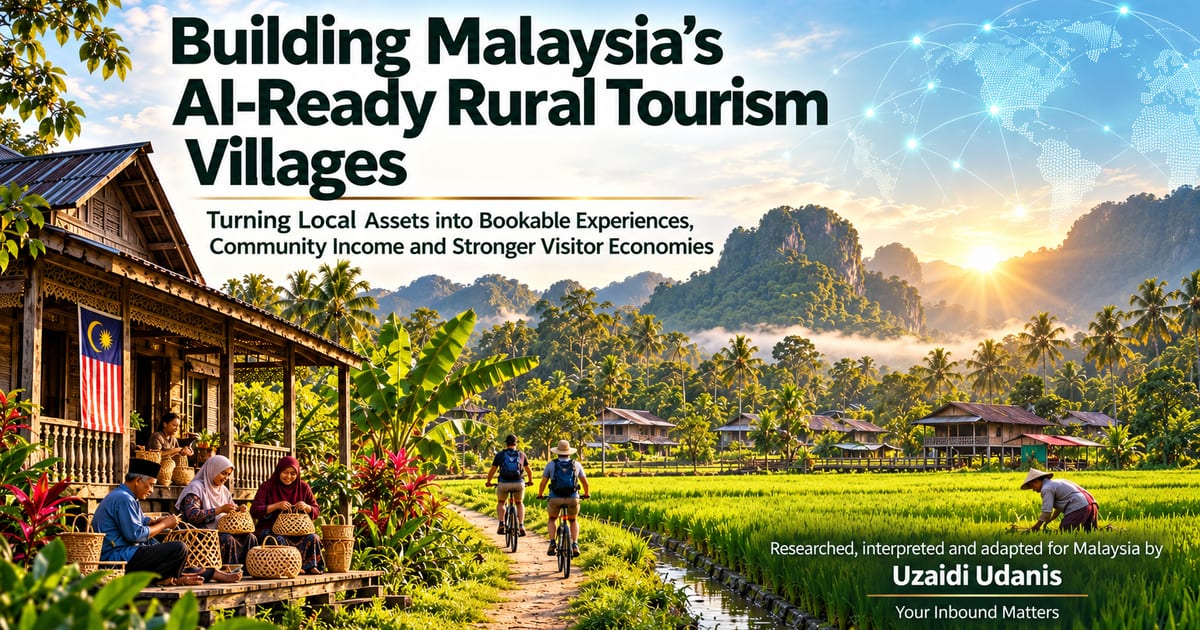
Building Malaysia’s AI-Ready Rural Tourism Villages Based On UN Tourism
Turning Local Assets into Bookable Experiences, Community Income and Stronger Visitor Economies
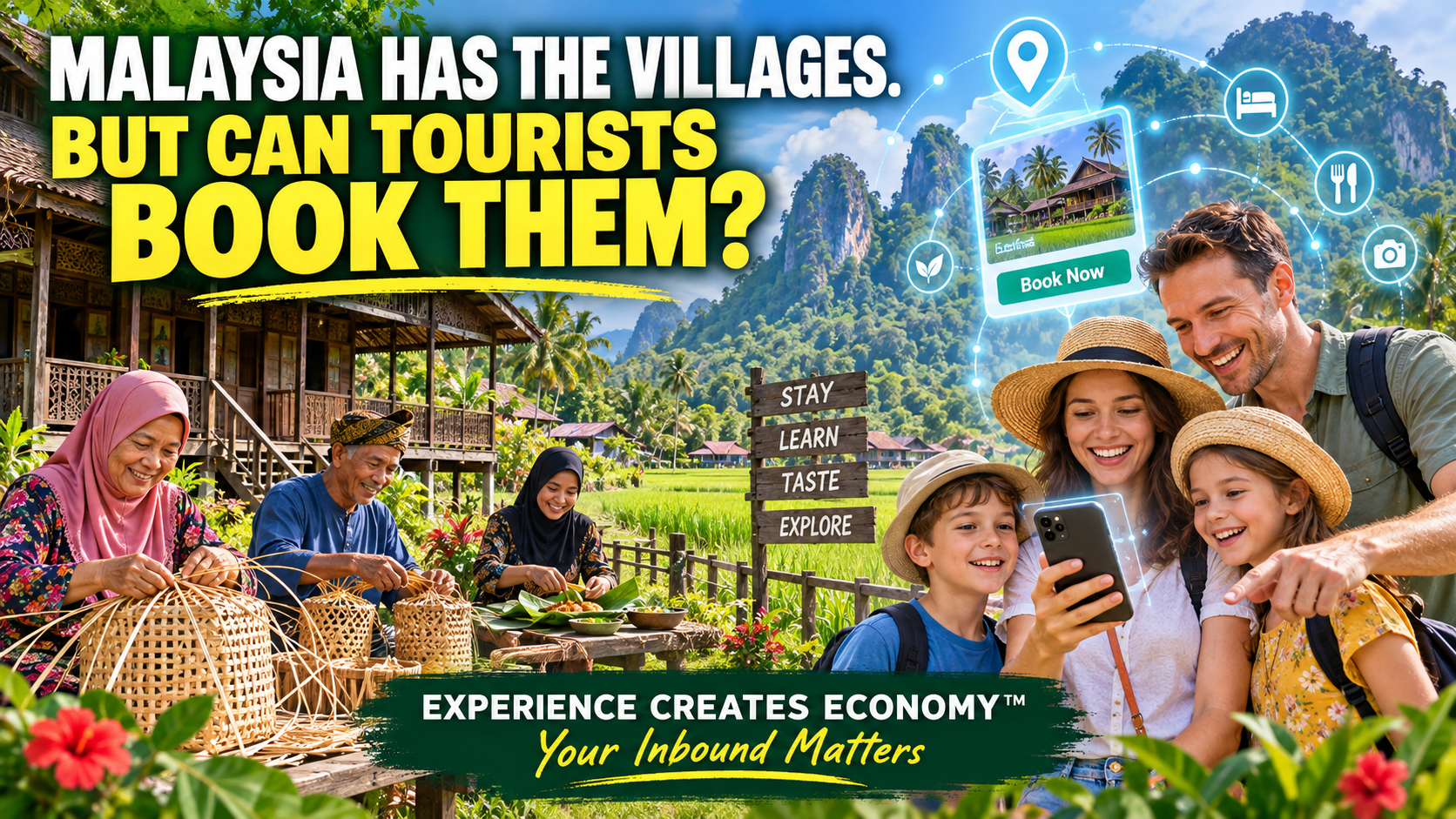
Malaysia has thousands of beautiful villages
We have paddy fields, orchards, fishing communities, traditional houses, local food, crafts, rivers, forests and stories passed down through generations.
The assets are already there.
But here is the uncomfortable question:
Can travellers find them?
And if travellers find them, can they understand what is being offered?
More importantly, can they book and pay immediately?
A village may have a beautiful waterfall. But a waterfall by itself is not yet a tourism product.
A farmer may grow the sweetest fruit. But an orchard by itself is not yet a bookable visitor experience.
A craftsperson may possess knowledge inherited from several generations. But if that experience has no clear description, price, schedule or booking method, it remains a hidden asset.
It exists—but economically, it may remain invisible.
Tourism Must Strengthen the Village
A recent UN Tourism publication, Leveraging Tourism for Inclusive and Resilient Rural Communities, presents good practices in social sustainability from its Best Tourism Villages Network.
Its message is highly relevant to Malaysia.
Rural tourism should not be measured only by how many buses enter a village.
We should also ask:
How many local people earned income?
How many small businesses received business?
Were women and young people included?
Did visitors buy locally produced food and crafts?
Did tourism help preserve the village’s culture and environment?
Did the community become stronger after the visitors left?
Because a crowded village does not necessarily mean a prosperous village.
Sometimes the tourists arrive, take photographs, use the toilet and leave.
The village receives the traffic. Somebody else receives the money.
That is not the visitor economy we should build.
From Local Asset to Bookable Experience
The opportunity begins when we change how we look at rural assets.
A paddy field can become a guided farming and storytelling experience.
A traditional kitchen can become a village cooking class.
A fishing community can offer a responsible fisherman-for-a-day experience.
A local bladesmith can allow visitors to forge their own Malay parang.
An orchard can offer fruit tasting, harvesting, storytelling and a farm-to-table meal.
The asset becomes an experience.
The experience becomes a product.
The product becomes bookable.
The booking creates income.
This is what we mean when we say:
EXPERIENCE CREATES ECONOMY™
One experience can benefit more than one operator.
A visitor who books a village experience may also pay the guide, homestay owner, driver, cook, farmer, craftmaker and local shop.
Tourism income begins to circulate inside the community.
That is the real power of rural tourism.
The Community Cannot Be a Decoration
Too many tourism programmes are designed for the community without being designed with the community.
Local people are invited to the launching ceremony. They appear in the photographs. But they are not always involved in deciding what happens next.
Sustainable rural tourism requires a different approach.
The community must help determine:
What experiences should be created
What stories should be shared
What areas should be protected
How visitors should behave
Who should receive the opportunities
How tourism income can be distributed more fairly
Local people should not merely become workers in somebody else’s tourism project.
They should become owners, partners, hosts and decision-makers.
Digitalisation Must Go Beyond Social Media
Many tourism entrepreneurs have Facebook, TikTok or Instagram accounts.
That is helpful—but having social media does not automatically make a business digitally ready.
An AI-ready rural tourism business needs clear digital identification.
Travellers and search platforms should be able to understand:
Who you are
Where you are located
What experience you provide
Who the experience is suitable for
What is included
How much it costs
When it is available
How to contact, book and pay
Today, travellers increasingly use Google, online travel marketplaces and AI platforms to plan their journeys.
If these systems cannot understand the experience, the experience may not appear when travellers are searching.
Our rural tourism businesses must therefore become:
Visible. Bookable. AI-ready.
AI should not replace the warmth of a local host.
It should help the world discover that host.
Malaysia Does Not Need to Copy Other Destinations
Malaysia’s rural tourism villages should not become smaller versions of Bali, Phuket or other famous destinations.
Our strength is our identity.
Our kampung lifestyle.
Our food.
Our farms.
Our multiracial communities.
Our forests and rivers.
Our crafts and traditions.
Our local stories.
The objective is not to manufacture something artificial for tourists.
The objective is to uncover what is already special, package it professionally and connect it to the market.
A New Rural Tourism Framework for Malaysia
Malaysia should identify selected villages and help them progress through a practical transformation journey:
Discover Local Assets → Design Local Experiences → Develop Bookable Products → Build Digital Identification → Connect to Marketplaces → Improve AI Visibility → Generate Community Income
This transformation requires collaboration among communities, tourism operators, government agencies, universities, technology providers and market-distribution partners.
Training alone is not enough.
A successful programme must produce measurable outcomes:
Rural tourism businesses digitally identified
Bookable local experiences created
Women and youth entrepreneurs involved
Local suppliers connected
Experiences listed through relevant sales channels
Enquiries and bookings generated
Community income measured
Heritage and natural assets protected
The Future Is Already in Our Villages
Malaysia does not lack rural tourism potential.
We lack enough systems to transform that potential into sustainable economic opportunities.
The next great Malaysian tourism experience may already exist in a village.
It may be with a farmer, craftmaker, fisherman, grandmother, traditional cook or young local storyteller.
Our responsibility is to help the world find it, understand it and book it—without taking its ownership away from the community.
That is how rural tourism villages become stronger visitor economies.
That is how local assets create local prosperity.
And that is why we believe:
EXPERIENCE CREATES ECONOMY™
To download the UN Report, please go toDownload The UN Report
About the author
Uzaidi Udanis is an AI Inbound Tourism Strategist and Founder of Your Inbound Matters. With more than 40 years of experience in inbound tourism, he advocates for tourism businesses and destinations to become visible, bookable and AI-ready while creating stronger local economies.
Source acknowledgement: This independent article was researched, interpreted and adapted for Malaysia with insights from UN Tourism’s publication, Leveraging Tourism for Inclusive and Resilient Rural Communities – A Collection of Good Practices on Social Sustainability from the Best Tourism Villages Network by UN Tourism. It is not an official UN Tourism publication.